


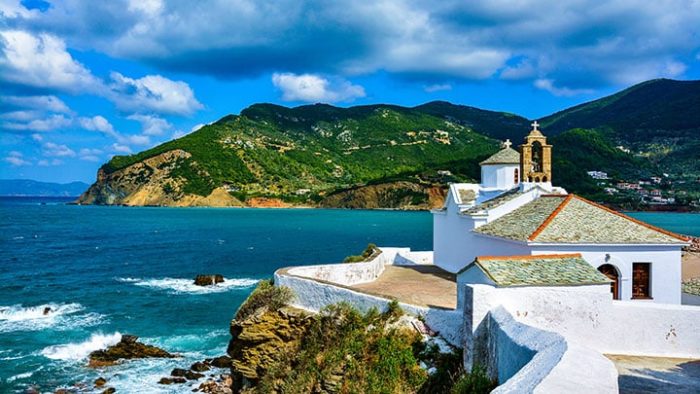
Weather in Skiathos, Skopelos and Alonissos
The Northern Sporades sit out there in the North Aegean, far enough from the mainland to feel “open sea”, but close enough that the land still shapes the wind. If you are planning a day cruise or a multi-day hop between Skiathos, Skopelos, Alonissos, and the National Marine Park, the weather is the thing that decides the route, the swim stops, and how relaxed everyone feels on board.
I run boats around Greece, and these islands are a classic case of “same forecast, different reality”. A few miles and one headland later, it can be glassy calm or choppy, so it pays to understand the patterns and the local quirks.
The Climate of the Northern Sporades
The Northern Sporades are an island chain stretching across the southern part of the North Aegean. Their geographic location leaves them exposed to both north and south winds, while Psathoura, the easternmost island, is also vulnerable to eastern weather systems. Due to the proximity of Mount Pelion to the west, they are generally protected from western systems.
Geographically, you are looking at islands off the east coast of mainland Greece, roughly opposite Volos and the Pelion peninsula. That “gap” between Pelion and the Sporades acts like a corridor for wind. When the north is on, the fetch can build fast in open water, but you can still find lee shores and tucked bays if you know where to go.
For official background on the region and what each island offers, the Greek National Tourism Organisation is a solid starting point. For the bigger-picture marine forecast, I often cross-check with the Hellenic Navy Hydrographic Service (marine weather products and notices can change, so always check close to departure).
How to reach the islands
Skiathos is usually the easiest entry point. It has an airport and frequent ferry connections, so most charters and private cruises start there. Skopelos and Alonissos are reached by ferry from Skiathos, Volos, Agios Konstantinos, and Mantoudi on Evia depending on the season. If you are coming by car, you typically drive to a mainland port and continue by ferry. No need to over-plan timetables months ahead, they shift with season and demand.
If you are meeting a skipper for a day trip, allow a little buffer for the port. In July and August, Skiathos town gets busy, parking is tight, and the quay can be a circus at changeover time.
Timetables, opening hours and routes can change without notice. Always double-check locally before you travel.
What to do on a “normal” weather day
When the breeze is light, the Sporades are perfect for the simple stuff. Slow cruising between coves, long swims, and a late lunch in a small harbour. Skiathos gives you iconic beaches and quick hops. Skopelos adds pine-covered slopes and pretty villages. Alonissos is more about nature, quieter bays, and the Marine Park vibe.
If you like diving and snorkelling, visibility is often best when the wind has been calm for a day or two. For local diving info and conditions, have a look at portoscuba.com, especially if you want to combine a cruise with a proper dive plan.
Spring and Summer Weather in the Northern Sporades
In early spring (March), cold fronts from the Balkans create strong north–north-easterly winds, which are gradually replaced by southern systems throughout April and May. By late spring and early summer (May–June), winds are generally light, with local breezes blowing in the afternoon. Starting in mid-summer (July) and into August, the Meltemi begin to blow, overriding the local breezes. The Meltemi are strong north‑easterly winds that intensify in the midday and afternoon and weaken at night. In the fall (September–October), these winds gradually fade, and by late autumn, the first cold fronts and north winds signal the coming of winter.
From a skipper’s point of view, May and June are the easy months. Water is warming up, the ports are not yet at peak pressure, and you can usually plan longer legs without everyone getting tired from motion. You still get a surprise day now and then, especially in early May, so I always keep a sheltered Plan B.
July and August are peak season for a reason: clear skies, hot days, and that bright Aegean colour. But it is also the time when Meltemi days can pin you down or force you to stay on the protected side. On motor yachts you can punch through more comfortably than on smaller open boats, but even then, comfort matters. On sailboats, the Meltemi can be brilliant sailing if the crew is up for it and the route is chosen smart. If not, it turns into a wet, noisy day and nobody wins.
September is my favourite compromise. Sea temperature is still great, the light is softer, and the crowds ease off. Winds are often more settled, though you can still get a late Meltemi burst. October can be stunning, but the odds of a front increase. If you are booking late season, keep your schedule flexible and don’t lock yourself into one “must‑do” beach.
Seasonal feel, crowds, and who it suits
Families usually love late June and early September. Less chaos in the ports, easier swim stops, and the heat is not as punishing for children. Couples who want quiet coves and sunset drinks tend to enjoy May, June and September. Groups that want lively nights and full beach service aim for July and August — just accept the busy quays and the higher chance of wind‑driven route changes.
If you are travelling around Orthodox Easter, the islands feel different. Some places are still waking up, but the atmosphere is special and very Greek.
Sun, Apr 12 2026
And if your trip lines up with the Holy Spirit holiday, expect a short spike in domestic travel and fuller ferries. It is not a deal‑breaker, just something to know when you are trying to move between islands.
Monday, June 1 2026
Rainfall in the Sporades
Regarding rainfall, the northern sections receive a fair amount in the spring. By late spring and early summer, local clouds often develop in the midday and afternoon, leading to brief showers, especially in the western areas. In late summer and early autumn, local thunderstorms can affect the islands in the late afternoon and early evening hours.
Spring showers are usually quick, and they can actually make the day nicer afterwards — cleaner air, better visibility, and that pine smell from Skopelos is unreal. The thing to watch is not the rain itself, it is the gusty wind shifts around the cells. You can go from flat calm to a sharp squall and back again in twenty minutes, so we keep an eye on the horizon and don’t anchor too close to a lee shore.
Late summer thunderstorms are typically local and short‑lived, but when they hit, they can hit hard. If you see the classic build‑up over the hills in the afternoon, plan your swim and your harbour arrival earlier. It is also when you get those dramatic sunsets after the storm clears — worth it if you time it right, but you need to be a bit careful.
Generally, temperatures do not drop very low in the spring. In the summer, coastal breezes and the Meltemi significantly influence the climate, making it milder with lower maximum temperatures than the nearby mainland.
That is why a boat day here can feel easier than a mainland beach day. Even on hot weeks, you have airflow, shade on board, and the option to jump in whenever you want. Water clarity is usually best in settled weather, and it can go milky in exposed bays after a windy day, especially where sand is fine.
Because of the islands’ geography, they are affected differently by various weather systems. However, since there are numerous natural anchorages beyond the main ports, a suitable and safe spot can almost always be found.
Practical onboard tips for comfort
- Start earlier on windy days. Morning is often calmer before the Meltemi peaks, so we do longer crossings early and keep afternoons for sheltered bays.
- Pack a light windbreaker even in August. On the water, it can feel cooler once you are wet from swimming.
- If someone gets seasick, sit them mid‑boat, keep them looking at the horizon, and avoid heavy food before the crossing. Simple stuff, but it works.
- Do not rely on one famous beach as the whole plan. In the Sporades, the “best” bay is the one that is calm that day.
Sea and outdoor activities depend on the weather and your own fitness level. Always follow local safety advice and skipper instructions.
What to Look Out For
Skiathos: When the wind is from the north, it affects the main port with wind but no significant swells. However, it makes mooring at Lalaria and the intermediate sections near the small Skantzoura islets impossible, or can cause a surge (ground swell) at Koukounaries. When the wind is from the south, the main port is unaffected, but the western and south‑western areas do not provide safe anchorage.
On Skiathos, the “postcard” north coast is the first thing people ask for, especially Lalaria. On a calm day it is magic. On a north wind day, it becomes a no‑go for comfort and sometimes for safety, depending on the boat and the sea state. The south coast is your friend then, with more options to tuck in. Koukounaries can also surprise you with that long‑period surge, even when it looks fine at first glance.
Skopelos: Weather significantly affects the area just outside the entrance to the main harbour during north winds or afternoon breezes. All other ports and mooring bays on the south and west sides of the island remain unaffected. Southern winds do not affect the main harbour but can create difficulties at the entrances of Agnontas and Stafylos.
Skopelos is generally kind to you because it has so many indentations and lee spots. The main harbour area can be awkward when the breeze funnels across the entrance, especially with traffic and ferries moving. If you are heading for Agnontas or Stafylos in a southerly, you plan your approach carefully and keep a second option ready. The island is also great for a mixed day: swim in a bay, then a short hop to the harbour for a walk and food.
If you want official island info and cultural pointers, Skopelos has a useful reference page on Wikipedia that helps visitors get their bearings before they arrive.
Alonissos: A north wind brings a surge into the main harbour but leaves southern mooring areas (e.g., Steni Vala, Tzortzi, Milia, etc.) unaffected. A south wind creates heavy swells in the main harbour and the south‑west of the island, along with a surge that weakens as you move east. Vasiliko on Peristera island remains well‑protected from all weather conditions, as does Gerakas, provided you make it inside the bay in time.
Alonissos is where the mood changes. It is greener and quieter, and once you start moving toward the Marine Park area, you feel further away from the busy Aegean lanes. In north winds, I like the southern mooring areas because they stay comfortable and you can still swim with good clarity. In a south wind, the main harbour can get unpleasant fast, and the south‑west side is not where you want to be hanging around. If you have the option, you move east and find smoother water.
If nature is your priority, Alonissos is also the gateway to the protected area around the Marine Park. Rules and zones matter there, so it is worth reading the official park information before you go: National Marine Park of Alonissos and Northern Sporades.
Kyra Panagia: The “Planitis” bay is completely protected from all weather conditions once inside; however, its entrance is hit by heavy swells during northern systems. At Agios Petros, a surge enters when there is a strong northern current, while southern winds make the area unsuitable and unsafe for mooring.
Kyra Panagia is one of those places that feels like a reward when you get it right. Planitis is a proper shelter once you are in, but the entrance can be nasty with northern swell. That is the detail people miss when they look at a simple wind arrow. If the sea is running, you time it, you keep the boat under control, and you do not force it just because “we came all this way”. Agios Petros can also get that uncomfortable surge with strong northern current, and in southerlies it is simply not the place to spend the night.
Choosing the right trip style
Day trips are perfect when you want a taste of the islands without committing to cabin life. You can focus on one area, usually Skiathos south coast plus a hop toward Skopelos if conditions allow. Multi‑day trips are where the Sporades shine. You can slow down, chase the best water, and adjust the route around the wind rather than fighting it.
Sailboats are brilliant in settled conditions and can turn a Meltemi day into a real sailing experience, but they need a crew that is happy with heel and spray. Motor yachts give you more control over timing and comfort, especially for families and mixed groups, but the sea state still decides the smoothness. Either way, the skipper’s local knowledge matters more than the boat’s brochure.
Our local team of skippers, travel agents and scuba instructors with over 20 years of experience in Halkidiki is here to help you.
Booking and route planning
If you tell us your dates, your group, and what you care about most, beaches, snorkelling, quiet bays, or a harbour lunch, we can suggest the best base and a realistic route that fits the season’s wind pattern. If you are not sure whether a day cruise or a two or three day trip makes more sense, ask and we will talk it through.
If you’d like to explore the coast, ask us about day trips at sea and sailing boat options.
call us: +306980700070
send a message via WhatsApp
call or text us on Viber
send a message via Messenger
Don’t forget to mention:
- Number of persons, possible dates
- The hotel you’ll be staying
- The activity you are interested in