


North Aegean islands for real sailing days
If you have already done the easy island hops and want something wilder, these three islands in the North Aegean deliver. As a skipper coming up from Halkidiki for multi-day trips, I always say the same thing: here you sail for the sea itself, not for beach bars.
Distances are bigger, weather changes faster, and the rewards are huge. Plan with flexibility, keep a close eye on the forecast, and treat every anchorage with respect.
Sea and outdoor activities depend on the weather and your own fitness level. Always follow local safety advice and skipper instructions.
Limnos
Limnos, located in the North Aegean, has an area of 476 square kilometres and a coastline of 259 km. The island’s capital and main port is Myrina. Myrina is 84 nm from Mytilene and 160 nm from Thessaloniki. For official background and practical info, the Lemnos page on Wikipedia is a solid starting point.
From Northern Greece, most crews reach Limnos by ferry or by yacht on a longer passage from the Sporades or the Kavala area. If you are coming from Halkidiki, it is not a casual day run. It is a proper leg, and you want an early start and a stable forecast, especially when the meltemi is in the mood.
Timetables, opening hours and routes can change without notice. Always double-check locally before you travel.
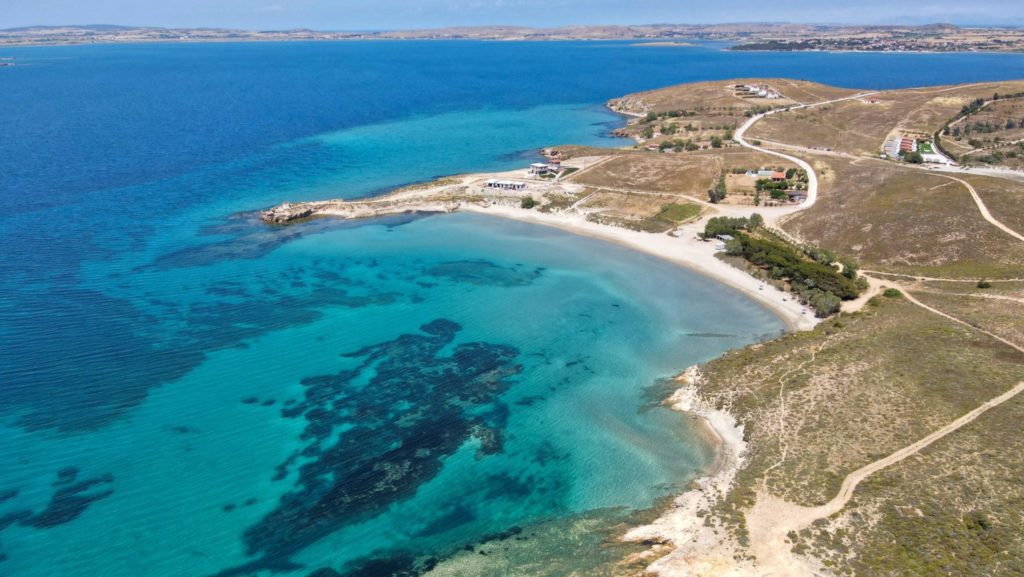
Lemnos is a purely volcanic island with low hills and sparse vegetation. Its indented coastline forms multiple bays with great beaches. The two main bays are Moudros in the south and Mpournias in the north. To the east of the island, near the village Kontopouli, are the salt lakes Alyki and Chortarolimni, important habitats visited by rare birds.
Those salt lakes are one of the reasons Limnos feels different. Even in mid-summer, you can have a quiet moment there with birds and wide open sky, then be back at the sea in minutes. If you visit, keep it gentle and respectful — it is a sensitive area and sometimes the light is so sharp you forget how exposed you are.
Lemnos is exposed to fierce winds for much of the year, so Homer called it “Anemoessa”. It is an ideal place for sailing and windsurfing. This isn’t marketing — it’s reality. In July and August the wind can sit at a steady force for days and chop builds fast in open water. For sailing yachts it can be a dream if the crew is comfortable; for motor yachts it means you pick your windows and avoid pushing the boat and people too hard.
My usual advice is to treat Limnos like a small sailing region in its own right. You do not need to rush. Pick a couple of good stops, give yourself time to wait out a windy day, and enjoy the island properly. Water clarity is generally very good, and around rocky points it turns that deep blue that makes you want to jump in even when the wind is still whistling.
Despite the rocky ground, Lemnos is quite fertile and produces excellent cereals, wine, figs, raisins, almonds and honey. If you like sampling local produce, this is a great island to eat simply and well. Ask for the local wine and don’t skip the cheese if you see it on the table — tavernas here feel honest, not staged.
The island offers plenty of fresh, tasty fish. The rocky shores and numerous reefs around the island make it an ideal spot for underwater fishing. If you dive and want to do so safely with local guidance, have a look at portoscuba.com for general diving context and good practices in Greek waters. Even if you’re only snorkelling, reefs and rocky shelves can surprise you with life — but also with currents and boat traffic near popular bays, so keep a proper lookout.
Season-wise, Limnos is nicest when you want space. June is bright and fresh with fewer boats, and September often gives warm seas and calmer days. In peak August you will still find room, but Myrina and popular beaches get busier and parking on land can be a bit of a mess. On the water it stays more open than the Cyclades, which is exactly why many of us love it.
If you are thinking of a longer charter that includes Limnos, it suits crews who enjoy real passages, couples who like quiet nights at anchor, and groups that want a mix of sailing, food and nature. Families can do it too, but choose calmer months and keep daily legs shorter so children don’t get tired and grumpy by day three.
If you want help matching the right boat to the season and your crew, drop us a message and we will suggest a realistic route.
If you’d like to explore the coast, ask us about day trips at sea and sailing boat options.
Samothraki
Samothraki is in the north-eastern Aegean and has been known since antiquity as the “Holy Island”, where the Kaveiria Mysteries — similar to the Eleusinian Mysteries — were held. The island is about 22 nautical miles from Alexandroupolis. It can be reached via Alexandroupolis or via Kavala when sailing from Northern Greece. For a quick cultural overview, see Samothrace on Wikipedia.
Samothraki is one of those islands you feel before you arrive. The mountain rises steep from the sea and you can see weather building around it. When the wind wraps around the land, conditions can differ markedly on each side, so your anchoring plan needs thought — not just “we will see”.
Sea and outdoor activities depend on the weather and your own fitness level. Always follow local safety advice and skipper instructions.
According to Homer, the mountainous part of the island (called Saos) was used by the god Poseidon with his son Aginora to watch the battle of Troy. Deep canyons cut through the rock, fed by a dense network of streams.
What really sets Samothraki apart is the number of freshwater streams. The coasts are often sandy and studded with pale rocks. On the south side near Lakkoma is the beautiful beach Pahia Ammos, covered in sand. Then there is the exotic Vatos, where trees and cool freshwater meet the sea. At Kremasto a waterfall drops into deep blue water. Endless coasts around the island reveal secret beauties protected under Natura 2000.
This freshwater character isn’t just a pleasant detail — it shapes your whole day. After a hot sail you can hike a short way inland to feel cold water on your hands, then head back to the boat for a swim in clear salt water. It’s a rare combination in Greece and why nature lovers fall for the island quickly.
Because much of the island is protected and feels wild, Samothraki is not about big marinas and polished promenades. It’s raw, green and sometimes a little demanding. Bring good shoes for shore time and be prepared for sudden weather changes, especially in shoulder season when a calm morning can turn into a windy afternoon with steep short waves.
For planning, I always tell guests to check wind and sea state from an official source, not only from an app that looks pretty. The Hellenic National Meteorological Service is worth checking before you commit to a crossing. And when moving between ports, remember that start times, fuel stops and local procedures can change with season and conditions.
Timetables, opening hours and routes can change without notice. Always double-check locally before you travel.
The seasonal feel here is special. In July and August you’ll see more visitors, but it still never feels crowded. The water is warm, the mountain gives shade in places, and evenings can be cooler than you expect. In May, June and September the island is quieter and the hikes are better, though the sea can feel fresher and the wind more playful.
Who it suits: couples who want nature and quiet, groups of friends who enjoy hiking and swimming, and sailors who prefer a destination not built around tourism. If you want nightlife, this is not the place. If you want that moment anchored beneath a big dark mountain where you can hear water running ashore, this is it.
When you’re ready to plan a Samothraki leg from Northern Greece or as part of a longer route, send us your dates and crew profile and we will be straight with you about what is doable and what is not.
Not sure where to start? Contact our local travel agency for friendly, personalised advice, seasonal offers and travel options.
Agios Efstratios
Agios Efstratios is about 18 nautical miles south-west of Lemnos. It has an area of roughly 44 sq.km, with a harbour and the main village located in the north-west part of the island.
Agios Efstratios is small and low-key, and that is the point. When I bring a crew here after a windy leg, everyone relaxes. The harbour gives a sense of shelter and the island pace is slow. You do not come for big sights, you come for calm water, simple food and proper rest.
It has small, beautiful beaches with clear water and is known to those involved in underwater fishing. The island is ideal for peaceful holidays. Fantastic beaches, fresh fish and excellent cheeses attract visitors every summer. On the island there are small pensions, cafés, tavernas and bars where visitors can enjoy local hospitality and the serenity of the place.
On land it’s easy. You tie up, walk a few minutes, and you are in the village for coffee or dinner. It’s the kind of evening where you don’t need a plan — follow the aroma from the kitchen and sit down. If you travel around Orthodox holidays like
Sun, Apr 12 2026
orMonday, June 1 2026
, expect more Greek families and a warmer buzz, but still nothing extreme.The island’s port can accommodate a reasonable number of yachts. There are lovely swimming beaches: Aghios Antonios, Aghios Dimitrios, Ftylio, Lidario, Panagia and Kalami. A very nice experience is to sail round the island to the sea caves, many of which the Mediterranean monk seals use as refuge, as the area is protected by the Marine Park of N. Sporades.
When exploring by boat, keep your distance from wildlife and never approach sea caves closely if there is any swell. It can look calm and then a surge comes in — things can become dangerous very quickly. Protected areas have rules for a reason, so keep it respectful and quiet.
Sea and outdoor activities depend on the weather and your own fitness level. Always follow local safety advice and skipper instructions.
For divers there are good fishing spots around the islets Dodeka Apostoli, Daskalio and Velia.
Agios Efstratios is also a good choice for mixed groups. Some people can swim and snorkel all day while others stay close to the harbour and enjoy the village. For older travellers it’s comfortable because you’re not forced into long drives or steep hikes. For children, the calm coves on the right day are magical — just watch wind shifts because even a small island can have gusty corners.
If you are building a route that links Lemnos and Agios Efstratios, or want to add Samothraki as the wild card, we can help you choose the right boat and direction depending on the wind.
Our local team of skippers, travel agents and scuba instructors with over 20 years of experience in Halkidiki is here to help you.
Practical skipper notes for this area
- Distances are real. These are not short hops between crowded islands, so plan fuel, water and rest properly.
- Wind can blow for days, especially mid-summer. Great for sailing, tiring if you fight it. Sometimes the best call is a calm day in port — no shame in that.
- Anchoring needs care. Depths and holding can change quickly near rocky points, and swell wraps into bays more than people expect.
- Provisioning is easier in larger ports like Myrina. On smaller islands keep it simple and don’t expect supermarket variety.
How we usually plan a charter up here
- We start with your crew, not with a map. Kids, older guests, first-timers and experienced sailors all need different daily legs.
- We pick 2 to 4 main stops and leave space for weather. That flexibility is what makes the trip enjoyable, not stressful.
- We confirm local port conditions and any changes close to departure.
Timetables, opening hours and routes can change without notice. Always double-check locally before you travel.
If you want a route suggestion from Halkidiki toward the North Aegean, with a motor yacht or a sailing yacht depending on season, get in touch and we will reply with options that actually fit the forecast and your days off.
call us: +306980700070
send a message via WhatsApp
call or text us on Viber
send a message via Messenger
Don’t forget to mention:
- Number of persons, possible dates
- The hotel you’ll be staying
- The activity you are interested in